4

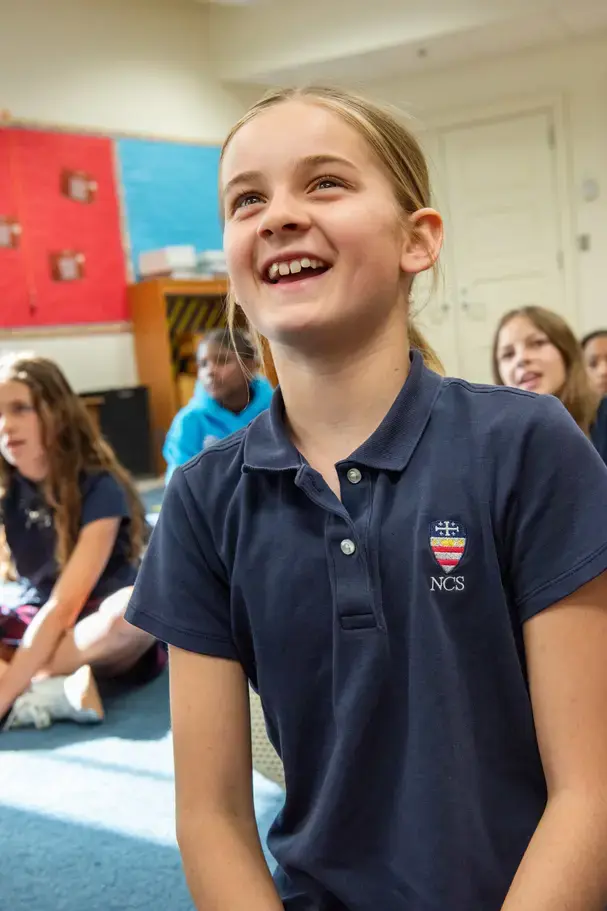
4th Grade is designed as a transition year into NCS, both academically and socially. Because students come to NCS from many different schools, the 4th-Grade teachers spend time not only on helping the girls adjust to a new school but also on understanding each student's learning style and identifying strengths and areas for improvement. For these reasons, report card grades are not given until the third trimester. Students move with their homeroom class to different teachers for most subject areas, allowing the girls to interact with a variety of teaching styles and personalities. Highlights of the 4th-Grade year include learning the class animal and performing a play related to a genre, such as fractured fairy tales, in the spring for Lower School students and parents.
  • Art 4

    The 4th-Grade program encourages the youngest NCS artists to explore and respond to art materials and begin to reflect on their process. Students investigate new concepts and develop coordination of their hands and minds to bring their ideas to life in their artwork. Art projects focus on exploration and play with materials and concepts, the 4th Grade class animal, and culture. 4th Graders attend two 55-minute art classes per rotation.
  • Chorus 4

    All NCS Lower School students participate in a Grade-level choir during the 7-day rotation. 4th-Grade students rehearse in their own choir. Participating in a choral ensemble is an invaluable experience for developing musicians. Rehearsal plans reflect, enhance, and reinforce the lessons from music class and challenge students to directly apply their learning to have a productive rehearsal and successful performance of the selected choral repertoire. Public performances are a critical extension of this learning. All required curricular performances take place within the school day except for the Festival of Lessons & Carols which is in the evening.
  • English 4

    4th-Grade English includes the study of literature, grammar, spelling, and creative and analytical writing. Throughout the year, students read and analyze novels through which they strengthen their reading comprehension, understanding of literary elements, and ability to express ideas with clarity and evidence. Along with lessons in vocabulary and spelling, students study foundational grammatical concepts, including parts of speech, paragraph structure, and rules of punctuation and capitalization. Writing assignments grow from literary analysis, personal experience, and imagination. Students also practice annotation and evidence-based writing, learning to support their interpretations with text-based details. Over the course of the year, students compose poetry, creative narratives, and a historical fiction book report, and they culminate their writing journey by authoring and illustrating their own original fiction books.
  • French 4

    The language curriculum is designed to foster beginning language skills and cultural appreciation, guiding students through the Novice range of the ACTFL Proficiency Guidelines. Instruction emphasizes the three modes of communication: Interpersonal, Interpretive, and Presentational.

    The purpose of the 4th-Grade curriculum is to develop beginning language skills and to instill in students an appreciation for other cultures.  By the end of 4th Grade, students are expected to perform at the Novice Low level of proficiency. They will grasp beginner language using memorized words, phrases, and formulaic expressions in highly predictable common daily settings. 

    Students are introduced to the 3 Ps of culture–Products, Practices, Perspectives–by learning about specific products (e.g., flags, food items) and daily practices (e.g., greetings, holidays) from various Spanish-speaking countries, fostering an appreciation for other cultures.

  • Library 4

    The 4th-Grade library program focuses on nurturing a love of reading while strengthening foundational library and research skills. Students engage in lively read-alouds, book talks, and interactive reading activities that promote curiosity and enthusiasm for books across a variety of genres. Throughout the year, students learn to locate materials using the online catalog–Destiny–and navigate the library shelves independently by call numbers. They practice selecting books that match both their reading levels and personal interests, and they begin developing research habits by extracting information from print and digital sources. Students are also introduced to library databases as they build emerging online research skills. Each class fosters a respectful, collaborative community where students share ideas and grow together as readers and thinkers.
  • Math 4

    4th-Grade math promotes students building a strong foundation in number sense through engaging lessons and hands-on practice. They develop fluency with place value, explore a variety of multiplication and division strategies, and take a deep dive into fractions and decimals. In addition, students investigate concepts in geometry, area and perimeter, measurement in both metric and customary units, and graphing. Through note-taking, partner projects, and real-world problem solving, students apply their learning in meaningful ways—strengthening their understanding while making connections with their classmates and the world around them.
  • Music 4

    4th-Grade music follows a curriculum called “Conversational Solfege” (Dr. John Feierabend, GIA Publications). Considered among the best adaptations of the Kodály and Gordon Methods, this curriculum includes movement, dance, ear-training, games, singing stories, close-listening of exemplary performances, and instrumental extensions. 

    The purpose of this curriculum is to teach music the same way a child learns a language (i.e., “sound before symbol”), by practicing the skills of thinking, singing, reading, and writing:

    Thinking: in music, this process is called audiation (hearing music in your mind without needing an instrument or another voice to sound it out, such as silently reading a book)

    Singing: singing or playing on instruments to communicate musical thought

    Reading: interpreting the symbols of musical notation, as well as syllables and hand signs

    Writing: transcribing the symbols of musical notation to communicate musical thought

    The goal of the course is that through a variety of musical experiences each NCS musician will explore and develop the knowledge and skills to independently demonstrate Grade-level musical literacy, and authentically apply those skills as a member of a performing ensemble.
  • PE 4

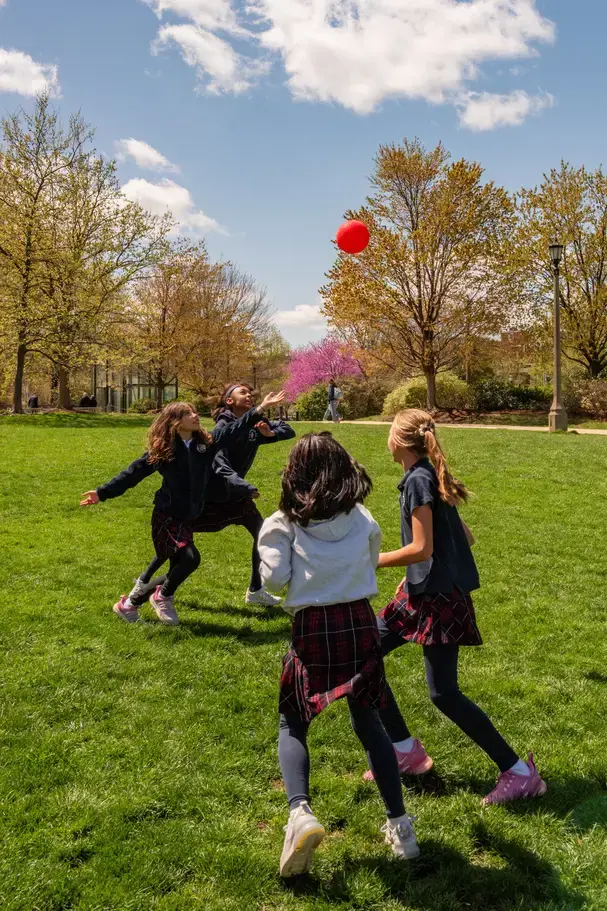
    The 4th-Grade physical education curriculum helps students develop a variety of motor skills and movement patterns in an atmosphere of trust, cooperation, and enjoyment. Students will learn fundamental, locomotor, non-locomotor and manipulative skills using different equipment such as balls, paddles, scoops, and rackets. Game strategy, tactics, and knowledge are introduced through cooperative and invasive games. Students will develop and practice good sportsmanship, persistence, and leadership skills. Participation in sports will encourage working well within a group, taking responsibility for personal and social behavior, accepting feedback, and following rules. The goal is to build confidence, celebrate each other's abilities, learn from mistakes and live an active and healthy lifestyle. 

    Units of study include: Cooperative Games, Field Hockey, Soccer, Volleyball, Kickball, Track and Field, Ultimate Frisbee, Softball, Basketball, Handball, Flag Football, Pilo Polo, Fitness, and Dance.
  • Religion 4

    4th-Grade religion orients students to the hospitality of Episcopal identity and spiritual practices found at NCS. Continuing to build a culture of respect and community sharing, students consider what a religion is and examples of religious identities and practices. After exploring sacred spaces like Grace Chapel, the Cathedral and its grounds, students complete a project in the makerspace. They create a map of the Cathedral itself and write poetry and prayers as they reflect on their experiences.
  • Science 4

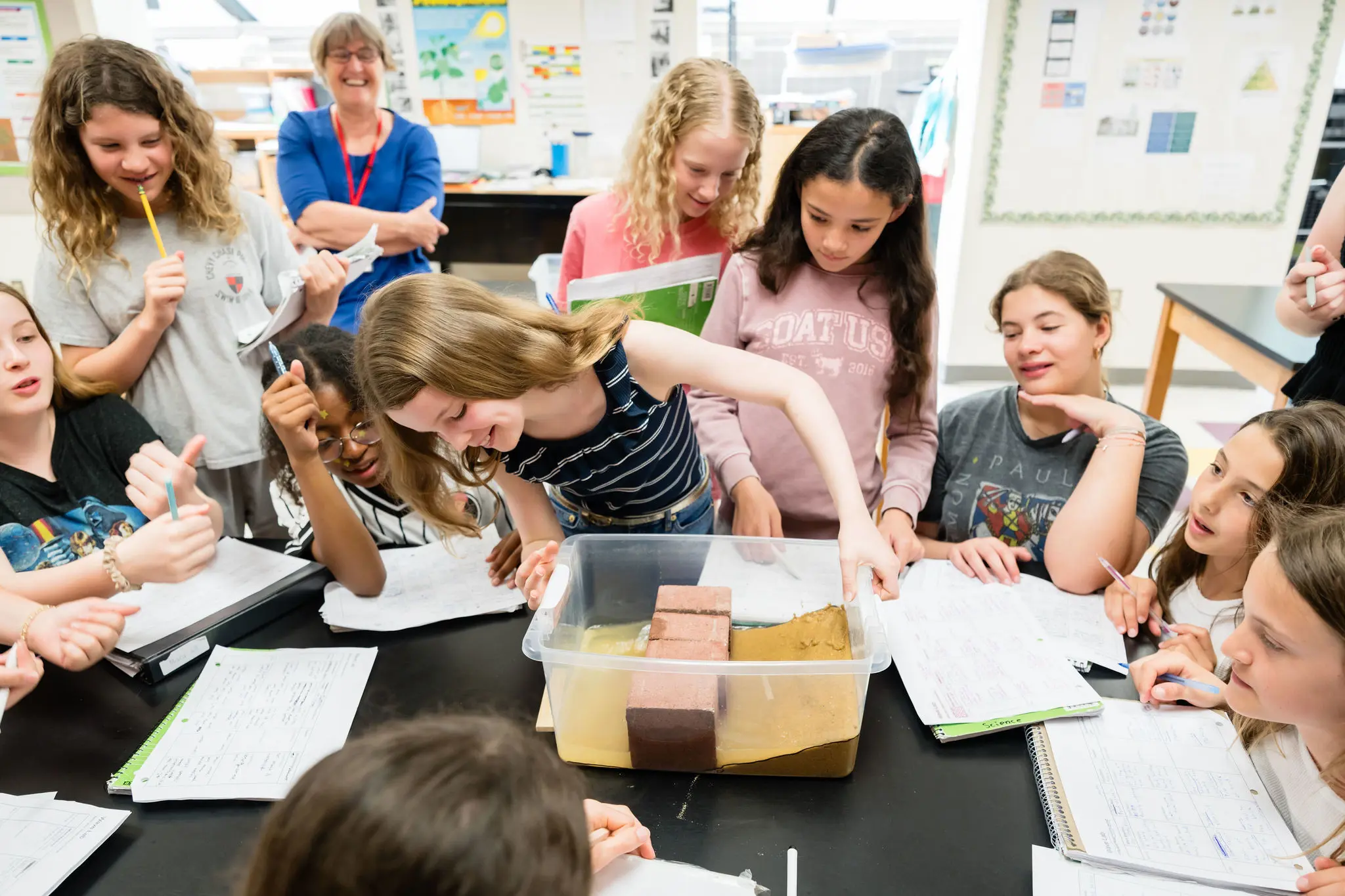
    4th-Grade science provides an environment for active investigation and discovery in a variety of scientific disciplines, including chemistry, life, earth, and space science. Students use the scientific method to investigate each topic. Interdisciplinary, inquiry-based projects incorporating all academic and community-building aspects of the curriculum are key components of the course. Experiments and activities integrated into the course are designed to connect students’ new knowledge and skills to their personal lives and communities.
  • Spanish 4

    The language curriculum is designed to foster beginning language skills and cultural appreciation, guiding students through the Novice range of the ACTFL Proficiency Guidelines. Instruction emphasizes the three modes of communication: Interpersonal, Interpretive, and Presentational.

    The purpose of the 4th-Grade curriculum is to develop beginning language skills and to instill in students an appreciation for other cultures. By the end of 4th Grade, students are expected to perform at the Novice Low level of proficiency. They will grasp beginner language using memorized words, phrases, and formulaic expressions in highly predictable common daily settings. 

    Students are introduced to the 3 Ps of culture–Products, Practices, Perspectives–by learning about specific products (e.g., flags, food items) and daily practices (e.g., greetings, holidays) from various Spanish-speaking countries, fostering an appreciation for other cultures.

  • Technology 4

    Students explore block-based coding and the fundamentals of how robots & computers work. They use Google apps, the Adobe suite, and similar programs to create and collaborate with classmates. Class content is often coordinated with other subjects for an interdisciplinary experience. Each Grade’s digital citizenship curriculum is designed to provoke age-appropriate discussions about our rights and responsibilities as digital citizens. In addition, the Lower School works in partnership with The Social Institute to guide and empower students to make good decisions with technology.
  • U.S. Geography 4

    In 4th Grade, we focus our social science learning on United States geography and use this discipline as a framework to develop important foundational skills. As students examine this country region by region, they are invited to see the topic of place through a variety of lenses—physical, economic, historical, and cultural, and better understand how they are all interconnected and influenced by each other. A primary goal of course completion is the introduction of strategies associated with effective non-fiction reading. One highlight of the year is a co-curricular project in which students deepen their understanding of artifacts through approaching a piece of art as museum visitor, artist, and curator. 

Department Faculty

  • Photo of Caitlin Allison
    Caitlin Allison
    Mathematics Teacher
  • Photo of Karin Anderson
    Karin Anderson
    English Teacher
    202-537-6310
    Bio
  • Photo of Paul Berry
    Paul Berry
    Director of Strength and Conditioning; Physical Education Teacher
    202-537-5457
    Bio
  • Photo of Catie Bliss
    Catie Bliss
    Field Hockey Coach
    2025375238
  • Photo of Eva Cavaleri
    Eva Cavaleri
    Senior Chaplain & Religious Studies Department Chair
    202-537-5619
    Bio
  • Photo of Masai Davis
    Masai Davis
    Assistant to the Head of Lower School
  • Photo of Aaron Goen
    Aaron Goen
    Director of Choral Music, Lower School
    202-537-6694
    Bio
  • Photo of Scott Gumosky
    Scott Gumosky
    Social Sciences Teacher
  • Photo of Tommie Hata
    Tommie Hata
    Director of information and Academic Technology
    202-537-2332
  • Photo of Rebecca Jones
    Rebecca Jones
    Head of the Lower School and Head of Faculty/Staff Recruitment, Retention, and Engagement
    202-537-6314
    Bio
  • Photo of Kate MacNutt
    Kate MacNutt
    Mathematics Teacher
  • Photo of Katie Miner
    Katie Miner
    Director of Counseling; Lower School Counselor
    202-449-3243
    Bio
  • Photo of Justine Mittelman
    Justine Mittelman
  • Photo of Samantha Neugebauer
    Samantha Neugebauer
    Learning Support Assistant
  • Photo of Jackie Popovich
    Jackie Popovich
    French Teacher
    202-537-6323
    Bio
  • Photo of Linda Robbins-Doyle
    Linda Robbins-Doyle
    Lower/Middle School Learning Specialist
  • Photo of Elinor Scully
    Elinor Scully
    Head of School
    Bio
  • Photo of Sophia Torres
    Sophia Torres
    Interim Library Assistant
    202-537-6305
    Bio
  • Photo of Keith Witherell
    Keith Witherell